Air Source Heat Pump vs Gas Boiler Running Costs
Is an air source heat pump better than a boiler? That's like asking if water is better than cola. Both can heat a home, but there are significant differences in cost, convenience, environmental impact, and installation requirements. If you're considering installing a heat pump instead of a boiler, this guide will help you.
Many homeowners are now comparing the costs and benefits of heat pumps and gas boilers. Rising energy prices, falling winter temperatures, and growing environmental concerns are prompting more people to consider heat pumps, especially after hearing about government subsidies to ease the cost burden.
You should also know that there's a compromise: a hybrid heat pump. This system integrates a heat pump into an existing boiler system, allowing you to reduce gas consumption without sacrificing immediate hot water supply.
Whether you're switching from gas heating to another heat source, this guide will help our readers choose the right heating solution for your home and other properties.
1. How do air source heat pumps and gas boilers work?
1) How a Gas-Fired Boiler Works
In short: The boiler burns natural gas to heat water, then distributes the hot water to radiators around the building.
Gas-fired boilers are connected to the national gas pipeline network.
The burner can be turned on manually or via a wireless signal from a thermostat. Upon startup, a piezoelectric igniter briefly ignites the gas before the valve opens, allowing the gas to flow and ignite. This delay prevents gas buildup and avoids an explosion upon ignition.
The burner's gas flame is located close to the heat exchanger, where water flows. The narrow channels within the heat exchanger create a large surface area to transfer as much heat as possible to the water.
Hot water is either stored in a tank or distributed to radiators and hot water taps as needed.
2) How a Heat Pump Works
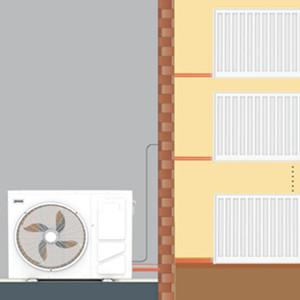
In short: An air-source heat pump absorbs ambient heat and compresses it to generate heat. This heat heats water, which is then distributed to radiators.
Heat pumps are classified into two types based on the location of the ambient heat source: ground-source heat pumps and air-source heat pumps. Both are electrically powered and utilize a heat exchanger system.
Air-source heat pumps use a fan to draw air into heat exchange coils filled with refrigerant. The refrigerant's temperature is much lower than ambient air, allowing it to absorb heat from the air. As the temperature rises, the refrigerant vaporizes, and the vaporized gas flows into the compressor. The compressor compresses the vaporized gas, raising its temperature to between 30 and 50 degrees Celsius. The compressed vaporized gas flows through a heat exchanger (similar to the heat exchanger in a boiler), transferring heat to water. The hot water is stored in a tank or distributed to radiators, while the condensed refrigerant is depressurized and flows back to the outdoor coils. Like a refrigerator, the refrigerant circulates in a closed loop and requires no replenishment.
Ground-source heat pumps absorb heat through underground pipes filled with a heat-conducting fluid (a mixture of water and antifreeze). These pipes are typically located in vertical boreholes about 100 meters deep or horizontal trenches about 2 meters deep. At these depths, the ground temperature remains around 10-12 degrees Celsius year-round.
The fluid absorbs heat from the ground and then flows back to the pump, where it passes through a heat exchanger, transferring heat to the refrigerant fluid. A heat pump compresses this fluid, raising its temperature, and then sends it to another heat exchanger, transferring heat to the water.
This water is then pumped to radiators, releasing heat into the building.
As you can see, air source heat pumps are much simpler in structure than ground source heat pumps, have less installation intrusion, and require less liquid management.
Since all the pathways ultimately lead to hot water flowing through your radiators, the choice between installing a heat pump or a gas boiler really depends on which option better suits your budget, your home or business, and your environmental responsibilities.
2. Installation Comparison: Heat Pumps vs. Gas Boilers
1) Heat Pumps: Installation
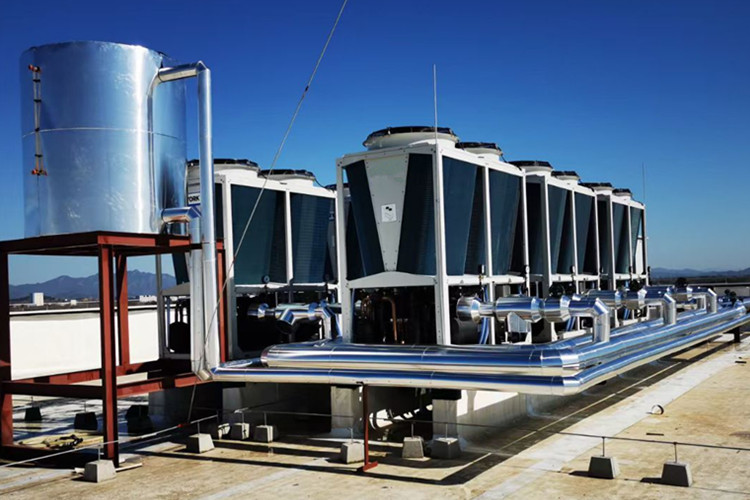
Air source heat pump installations are typically complex and need to be customized based on the specifics of your building and the type of heat pump you choose.
Ground source heat pumps require extensive groundwork to lay pipes, and are therefore primarily used for large properties or new construction.
Air source heat pump installations typically take less than three days, including building a stable, level foundation, installing the machine, wiring, and laying pipes. Air source heat pumps are suitable for most well-insulated residential and commercial buildings. The installation and supply cost of a heat pump can range from £10,000 to £25,000. You may also need new radiators and insulation for the heat pump to operate efficiently. However, government grants can help cover these costs; for example, the government provides a £7,500 subsidy for heat pump installations during the phase-out of fossil fuels.
2) Gas Boiler Installation
Gas boiler installation is generally quick and easy, especially when replacing a boiler of the same type. Finding a qualified engineer is not difficult, and installation can usually be completed in less than a day.
The average cost of installing a gas boiler is between £2,700 and £3,500, including the price of the boiler itself.
However, gas boiler installation becomes more complicated if your home is not yet connected to the main gas network. Connecting the gas alone requires foundation work and indoor piping, which can cost between £400 and £4,000. Currently, there are no grants available to help cover the cost of new gas connections.
3. Comparison of Operating Costs between Air Source Heat Pumps and Gas Boilers
1) Typical Operating Costs of Gas Boilers
Operating costs are one of the main reasons people consider replacing their heating systems and a key argument for sticking with gas boilers.
In 2025, the price of natural gas will be capped at 7 pence per kilowatt-hour, while electricity will cost 30 pence per kilowatt-hour. Therefore, the unit fuel cost of a gas boiler is almost a quarter of that of an air source heat pump.
However, the unit energy consumption method is only meaningful when efficiency is also considered. Even the most advanced Class A gas boilers lose approximately 10% of their energy for every unit of fuel consumed.
1 kilowatt-hour of natural gas produces 0.9 kilowatt-hours of heat.
According to data from the UK Gas and Electricity Market Authority (Ofgem), a two- to three-bedroom house consumes an average of 11,500 kilowatt-hours of natural gas per year. This figure doesn't differentiate between natural gas used for heating, hot water, and cooking. However, since cooking accounts for only 3% of total household energy consumption, while heating and hot water account for 61% and 17% respectively, the average annual natural gas consumption through a boiler is closer to 11,040 kWh. The actual consumption would be even lower if the house is well-insulated.
Based on 2025 prices, running a gas boiler would cost: 11,040 kWh x £0.07 = £772.80 per year.
Consider that energy prices in the UK are currently rising annually when making this decision.
2) Typical Operating Costs of Heat Pumps
At first glance, achieving the target of 11,040 kWh might seem much more expensive due to the 30 pence per unit cap on electricity prices. However, air source heat pumps typically have a coefficient of performance (COP) of 3.0. This means that for every unit of electricity consumed, the heat pump produces 3 units of heat.
To generate 11,040 kWh of heat for your home, a heat pump would require approximately 3,680 kWh of electricity. At current prices, this translates to 3,680 kWh x £0.30 = £1,104 per year.
Furthermore, it should be considered that most homes using gas boilers may not have ideal insulation, and good insulation is essential for installing an air-source heat pump. Gas boilers can quickly generate high temperatures to compensate for heat loss in older homes, while heat pumps provide a more consistent supply of hot water at around 50 degrees Celsius.
If your home has good insulation, or an Energy Performance Certificate (EPC) rating of B (which many new homes meet), then with a heat pump, your annual heating needs will be close to 3,780 kWh of heat or 1,260 kWh of electricity. This would result in an annual heating cost of only £378, compared to £264.60 for gas. The better the insulation of your home, the smaller the difference in operating costs between air source heat pumps and gas boilers.
3) Heat Pumps vs. Gas Boilers: Cost, Efficiency, and Emissions
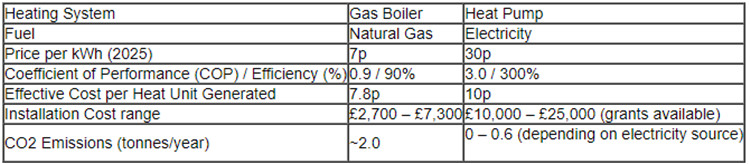
While electricity costs more than four times that of natural gas, air source heat pumps require fewer units to produce the same amount of heat and have significantly lower emissions. However, convenience and cost often outweigh the cost of air source heat pumps compared to gas boilers.
4. Are Heat Pumps More Environmentally Friendly Than Gas Boilers?
Gas boilers burn natural gas, a fossil fuel. The energy contained in this gas was produced millions of years ago by plants through photosynthesis. As these plants die and decompose, they release gases into underground gas chambers, which are now piped to homes for heating, hot water, and cooking. On average, each household in the UK using a gas boiler emits two tons of carbon dioxide into the atmosphere annually, exacerbating the greenhouse effect, contributing to global warming, and leading to extreme weather, unpredictable seasons, and changes in sea levels and ocean currents.
Gas boilers also pose a risk of leaking harmful gases (such as carbon monoxide) into your home and the surrounding atmosphere, causing air pollution and long-term health problems.
Heat pumps operate on electricity, which can be supplied by the UK National Grid or solar panels installed on your home. As renewable energy generation continues to grow in the UK, the country's reliance on fossil fuels is decreasing. If you use electric heating, especially if you generate your own electricity, you can reduce your household carbon dioxide emissions by up to two tons per year.
5. Heat Pump Boilers vs. Gas Boilers: Which is Right for Your Home?
Choosing the right heating solution depends on the condition of your home, such as its insulation, distance from the gas network, and your budget. For older homes with poor insulation, boilers can provide rapid heating at any time. Air source heat pumps are better suited for well-insulated buildings because they rely on highly efficient insulation. In addition to applying for heat pump installation subsidies, you can also receive financial assistance for insulation costs, significantly reducing heating costs.
However, the environmental benefits of heat pumps make them a key component in achieving net-zero carbon emissions in the UK. While operating costs are slightly higher, they do not emit any carbon dioxide or other potentially harmful gases. Heat pumps are completely safe, eliminating the gas leak or explosion risks common with gas boilers.
If you can afford the initial investment, replacing your existing heating system with an air source heat pump is an excellent way to reduce emissions.
If you don't want to give up the comfort of instant heating and hot water, hybrid heating systems combine all the advantages of heat pumps and gas boilers, reducing gas consumption by up to 82.5%. Choosing a hybrid heat pump system allows you to enjoy the benefits of both heating methods simultaneously.
6. Frequently Asked Questions: Heat Pump or Gas Boiler
1) Can I apply for a government subsidy to purchase a heat pump?
If you are replacing your fossil fuel heating system with an air source heat pump and you own the property, you may be eligible for a £7,500 government grant for the installation of a heat pump in England and Wales.
The property must also hold a valid energy performance certificate and be suitable for installing a low-carbon heating system. You can consult an MCS-certified heat pump installer for details.
In Scotland, you may be eligible for a similar £7,500 grant, plus an additional £7,500 interest-free loan.
Find out if you qualify for the boiler upgrade scheme.
2) Are heat pumps better than boilers?
That depends on how you define "better." They are more energy efficient, producing 3 heat units per unit of fuel consumed, compared to only 0.9 for most gas boilers. They are also more environmentally friendly, using electricity instead of gas, and are safer to install in your home.
On the other hand, gas boilers produce more heat faster, so you are guaranteed hot water at all times, even in poorly insulated homes.
3) Is a combined gas boiler gas-fired or electric?
Combined boilers are named for their integrated function of providing central heating and hot water. They can be powered by either gas or electricity, but gas boilers are generally cheaper.
4) Can a heat pump replace a boiler?
Air source heat pumps are designed to replace boilers in home heating systems. They provide central heating and hot water. However, unlike gas boilers which heat water on demand, heat pumps store hot water in a tank.
5) Are heat pumps cheaper than gas boilers?
By 2025, no indicators suggest that heat pumps are cheaper than gas boilers. As demand grows, proponents hope that the initial cost of air source heat pumps will decrease. Because heat pumps are electrically powered, they consume less energy but have slightly higher operating costs. However, this could change if natural gas reserves decrease, leading to higher natural gas prices.
6) How to replace a gas boiler with a heat pump?
The first step is to schedule a home inspection to determine if your home is a good fit for a heat pump. For an air source heat pump to be an effective heating method, your home should have good insulation and a modern radiator system.