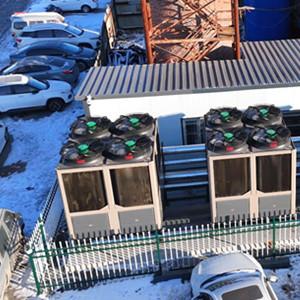
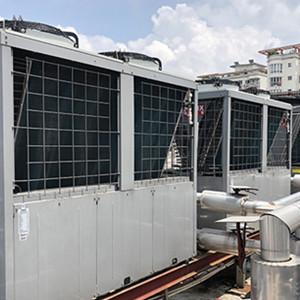
Air Source Heat Pump Dimensions
A heat pump absorbs heat from the outside environment and then delivers it indoors. Air source heat pumps absorb heat from the outside air, while ground source heat pumps absorb heat from the ground.
For a typical standalone air source heat pump, you need approximately 2 meters (6.5 feet) x 1 meter (3 feet) of outdoor space. An air source heat pump requires a water tank to be installed indoors. These are typical heat pump dimensions. Split-type systems require even more indoor space.
The table below summarizes the space you may need. Please read on for more detailed information on heat pump dimensions.
* System Unit Typical Dimensions (Four-Bedroom Residence)
1) Air-to-Water (Integrated) Outdoor Unit 1.5m x 1m
2) Air-to-Water (Integrated) Water Tank 1.3m x 0.5m
3) Air-to-Water (Separate) Outdoor Unit 1.5m x 1m
4) Air-to-Water (Separate) Water Tank 1.3m x 0.5m
5) Air-to-Water (Separate) Indoor Unit 0.7m x 0.5m
Typical heat pump dimensions for a 4-bedroom, 160 square meter residence.
1. Integrated vs. Split-Type Heat Pumps
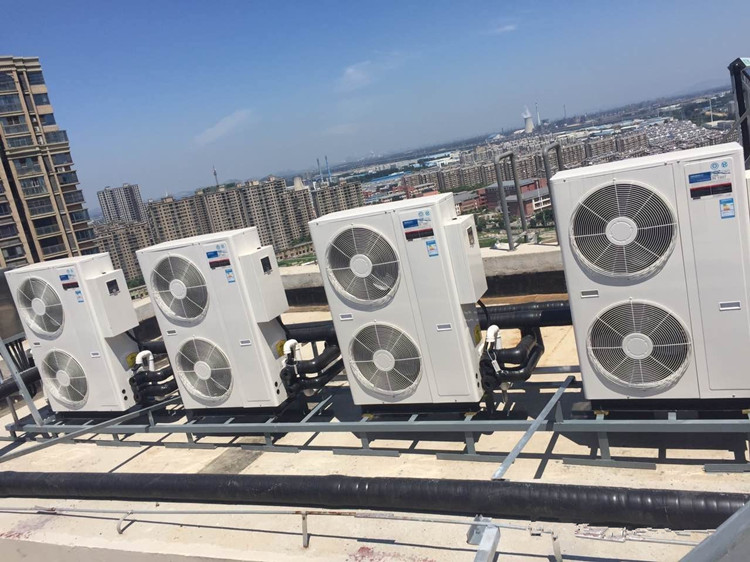
Another important distinction to make when discussing heat pump dimensions is between integrated and split-type heat pumps.
In an integrated system, all components, including the compressor, condenser, and evaporator, are integrated into a single outdoor unit. In an air-source heat pump system, the indoor unit is simply an air processor. In an air source heat pump system, hot water is pumped to an indoor storage tank.
A split-type heat pump consists of separate indoor and outdoor units connected by refrigerant piping. The outdoor unit contains the compressor and condenser. In an air-to-air system, the indoor unit exchanges heat with the indoor air. In an air-to-water system, the indoor unit uses refrigerant to heat water.
2. How much space is needed to install an air source heat pump?
In the UK, air source heat pumps are by far the most popular choice, as they don't require a large garden or any ground excavation.
3. The size of the heat pump and the space required depend on several factors:
1) Split or Integrated System
Integrated air conditioning systems take up less space, making them the most popular choice in space-constrained environments like the UK. Split-type heat pump systems require more floor space.
2) Power Required by the Heat Pump
Heat pumps come in various sizes. The power of the heat pump determines its heating capacity. This is discussed in detail on other pages of our website. In the UK, we use kilowatts (kW) to express the power of a heat pump. The right heat pump for your project depends on the size of your house (building area), the local climate, and your home's specific circumstances.
Selecting the right heat pump is complex. You should always consult a qualified HVAC expert, but there are some rules of thumb. For new or renovated homes, the required power is approximately 30-50 watts per square meter of building area. Therefore, a 165 square meter house might require a 7.5 kW heat pump.
In North America, heat pump power is typically measured in "tonnes." One tonne is equivalent to 12,000 British thermal units (BTU), or 3.5 kilowatts (kW). Our typical 7.5 kW heat pump is equivalent to a 2-tonne system in the US. North American homes are typically larger, and larger homes may require 3-tonne or 4-tonne heat pump systems.
4. How much outdoor space does an air source heat pump require?
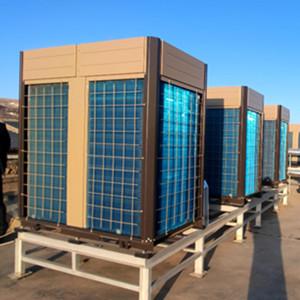
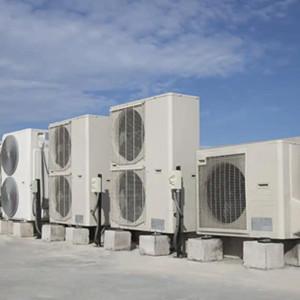
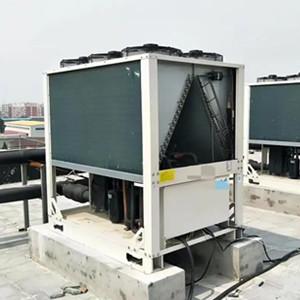
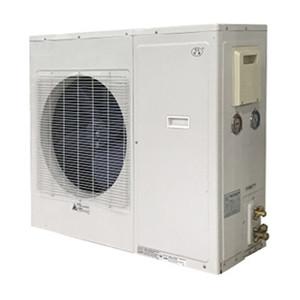
Typical outdoor unit heights are between 1 and 1.5 meters, and widths are between 0.5 and 1 meter. As you might expect, if you choose a more powerful system, the outdoor unit will likely be larger.
Besides the size of the air source heat pump, you also need to ensure adequate airflow around it. This is crucial because heat pumps need to draw air in from both the front and back to heat efficiently.
We believe a 2m x 1m space in the garden should be sufficient for most outdoor units.
5. Where should I place my air source heat pump outdoor unit?
Heat pumps should always be placed on a flat surface. They are typically heavy and prone to vibration, so they must be placed on a solid surface. It's best to place them close to a flat wall of the house, avoiding corners, as this allows for better airflow.
The outdoor unit can be installed away from the house, but this isn't always the best option. Water (integrated systems) or refrigerant (split systems) is supplied from the outdoor unit to the interior. The longer the pipes, the more heat is lost along the way, and the less efficient the system will be. This can increase your heating costs, especially in colder climates.
While a properly installed heat pump is generally not too noisy, we recommend against installing it directly under a window.
6. How much indoor space does an air source heat pump require?
This largely depends on whether you install a packaged or split-type air conditioner. Split-type air conditioners have more indoor components.
7. Indoor space required for a packaged installation
In a packaged heat pump (air source heat pump) installation, you only need one indoor hot water tank.
The required tank capacity also depends on your house and the number of family members. For example, a four-bedroom, two-bathroom house would require a tank with a capacity between 200 and 300 liters. This tank would be approximately 1.3 meters high and 0.5 meters wide. Additionally, space needs to be reserved around the tank for maintenance, piping installation, etc.
If your house uses a traditional gas boiler, you may already have an indoor hot water tank. Your HVAC engineer can advise on whether your existing hot water tank is compatible with the new air source heat pump. However, many houses in the UK have gas-fired combined boilers. These boilers provide instant hot water and cannot be used with a storage-type hot water tank. If you are using a gas-fired combined boiler and want to install an air source heat pump, you need to consider the installation location of the hot water tank.
8. Indoor Space Required for Split Air Conditioning Systems
In a split air conditioning system, some heat exchange occurs indoors. This is the exchange between refrigerant and water (air-water system) or air (air-air system).
The size of indoor units varies between manufacturers, but the indoor unit size of an air source heat pump air conditioner is generally roughly the same as that of a gas-fired boiler, approximately 70 cm x 50 cm x 30 cm. If you already have a gas-fired boiler, you may be able to replace it with an indoor unit.
If you are installing an air-water system, you need to consider the placement of the gas tank—this is the same as for a stand-alone installation.
For air-to-air air conditioning systems, the cooling effect depends on whether you choose a ducted or ductless system. Ducted systems use a central air processor that delivers hot air to various rooms in your home through a network of ducts. Ductless (or mini-split) systems consist of a series of independent units. We suggest you learn more about this information, as this topic can be quite technical.
How much space is needed to install a ground source heat pump?
Since ground source heat pumps (sometimes called geothermal heat pumps) absorb heat from the ground outside the house, you will need at least some garden space to install one. There are two types of ground source heat pumps: horizontal and vertical systems.
A horizontal drainage system involves laying the pipes horizontally at a shallow depth. Typically, installing a horizontal drainage system requires approximately 700 square meters of yard space.
A vertical drainage system involves placing the pipes in pre-drilled, deep holes. This system requires less outdoor space but is more expensive to install. It typically only requires about 11 square meters of yard space.
You will also need space to house the heat pump unit, which includes components such as the compressor. Its size is similar to the outdoor unit of an air source heat pump and can be placed in an outdoor machine room, garage, or storeroom.