+86 15603721115 tyler@lnashp.com

Leomon
  • Home
  • About us
  • Products
    • High Temperature Heat Pumps
    • Air Source Heat Pumps
      • Domestic Heat Pumps
      • Commercial Heat Pumps
      • Industrial Heat Pumps
    • Swimming Pool Heat Pump
      • Residential Swimming Pool Heat Pump
      • Commercial Swimming Pool Heat Pump
      • Spa Heat Pump
    • Hot Water Heat Pumps
      • Domestic Hot Water Heat Pumps
      • Commercial Hot Water Heat Pumps
    • Cold Climate Heat Pumps
      • Low Temperature Heat Pumps
      • EVI Heat Pumps
    • Air to Water Heat Pumps
    • Geothermal Heat Pump
      • Ground Source Heat Pump
    • DC Inverter Heat Pumps
    • Underfloor Heating Heat Pumps
    • Heat Pump Cylinders
    • CO2 Heat Pumps
      • R744 Heat Pumps
  • News
  • Contact us

News

  1. Home
  2. News
  3. How does Air Source Heat Pump Work?...

How does Air Source Heat Pump Work?

The working principle of an air source heat pump is actually quite straightforward; its core logic is not to "generate" heat, but rather to act like a natural transporter, moving free thermal energy from the air. Its mechanism is very similar to that of common air conditioners or refrigerators, relying primarily on the continuous circulation of a refrigerant within the system to transfer heat.
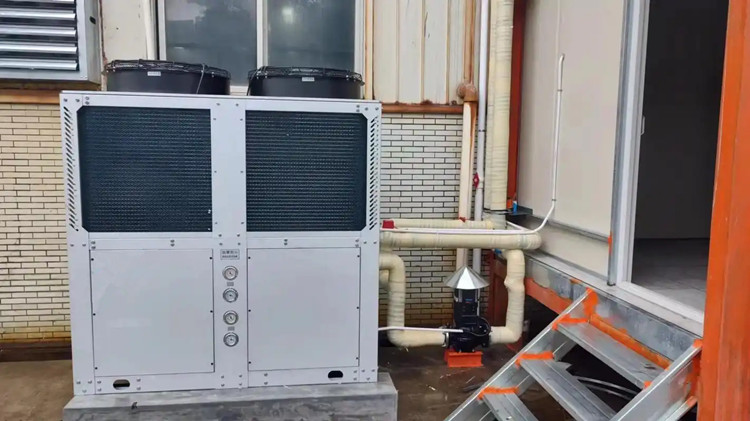
 

Specifically, this energy-transfer process consists of four consecutive steps:

1. Evaporation and Heat Absorption (Extracting energy from the air)

Inside the outdoor unit's evaporator, the liquid refrigerant exists at a very low temperature and pressure. When the outdoor fan blows air across the evaporator, the air still contains heat—even in the dead of winter. The refrigerant absorbs this heat, boils, and vaporizes, transforming into a low-temperature, low-pressure gas. This is the key to how an air source heat pump extracts energy from cold air.


2. Compression and Temperature Rise (Upgrading the thermal energy)

Next, this heat-laden, low-temperature gas is drawn into the compressor. Acting like a heart, the compressor performs work on the gas, compressing it into a high-temperature, high-pressure state. During this physical process, the gas temperature rises sharply to a level sufficient for indoor heating needs (typically ranging from 40°C to over 60°C).


3. Condensation and Heat Release (Releasing heat indoors)

The high-temperature, high-pressure refrigerant gas then enters the indoor condenser (such as a heat exchanger within underfloor heating pipes or radiators). Here, the refrigerant exchanges heat with indoor water or air, releasing a significant amount of heat to warm the room. As it loses heat, the refrigerant condenses back into a high-pressure liquid.


4. Throttling and Pressure Reduction (Preparing for the next cycle)

Finally, the high-pressure liquid refrigerant passes through an expansion valve (a throttling device). Its pressure and temperature drop instantly, returning it to a low-temperature, low-pressure liquid state. It then flows back to the outdoor evaporator to begin the next heat-absorption cycle. Summary


Through the continuous repetition of these four steps, the air source heat pump steadily transfers low-grade thermal energy from the outdoor air to the indoors, converting it into high-grade thermal energy for use. Notably, the system is fully reversible: in summer, simply by using a four-way reversing valve to alter the direction of the refrigerant flow, the system can transfer indoor heat to the outdoors, thereby switching the air source heat pump to cooling mode.
Related News

Advantages and Disadvantages of Using Air Source Heat Pumps for Heating

Advantages and Disadvantages of Using Air Source Heat Pumps

What is the Lifespan of an Air Source Heat Pump?

What is the Lifespan of an Air Source Heat Pump?

Advantages of using Air Source Heat Pump with Underfloor Heating

Advantages of using Air Source Heat Pump with Underfloor Hea

How effective is Residential Air Source Heat Pump Heating?

How effective is Residential Air Source Heat Pump Heating?

Will my Home Insurance Cover my Air Source Heat Pump?

Will my Home Insurance Cover my Air Source Heat Pump?

What Size of Air Source Heat Pump should be used for a 500 Square Meter House

What Size of Air Source Heat Pump should be used for a 500 S

Product Categories

  • High Temperature Heat Pumps
  • Air Source Heat Pumps
    • Domestic Heat Pumps
    • Commercial Heat Pumps
    • Industrial Heat Pumps
  • Swimming Pool Heat Pump
    • Residential Swimming Pool Heat Pump
    • Commercial Swimming Pool Heat Pump
    • Spa Heat Pump
  • Hot Water Heat Pumps
    • Domestic Hot Water Heat Pumps
    • Commercial Hot Water Heat Pumps
  • Cold Climate Heat Pumps
    • Low Temperature Heat Pumps
    • EVI Heat Pumps
  • Air to Water Heat Pumps
  • Geothermal Heat Pump
    • Ground Source Heat Pump
  • DC Inverter Heat Pumps
  • Underfloor Heating Heat Pumps
  • Heat Pump Cylinders
  • CO2 Heat Pumps
    • R744 Heat Pumps

tyler@lnashp.com

+86 15603721115

+86 15603721115

Cihu Technical Area, Maanshan. China

Latest Post

  • Air Source Heat Pump Electricity Consumption
    Air Source Heat Pump Electricity Consump
    2026-06-08
  • How does Air Source Heat Pump Work?
    How does Air Source Heat Pump Work?
    2026-06-08
  • What is the Lifespan of an Air Source Heat Pump?
    What is the Lifespan of an Air Source He
    2026-06-08
  • LatestPost

    • Air Source Heat Pump Electricity Consumption
      Air Source Heat Pump Electricity Consump
      2026-06-08
    • How does Air Source Heat Pump Work?
      How does Air Source Heat Pump Work?
      2026-06-08
    • What is the Lifespan of an Air Source Heat Pump?
      What is the Lifespan of an Air Source He
      2026-06-08

    Feedback

    Contact Us

    tyler@lnashp.com

    +86 15603721115

    +86 15603721115

    Cihu Technical Area, Maanshan. China

    MOBILE WEBSITE

    Copyright © 2015 Maanshan Leomon Energy-Saving Technology Co. LTD All Rights Reserved.

    • Skype.
    • E-mail
    • Whatsapp
    • Inquiry
    Inquiry Us Now !
    Inquiry Us Now !