The History and Evolution of Air Source Heat Pumps
Early Origins (1850s – Early 20th Century)The concept of heat pump technology dates back to the mid-19th century. In 1852, the British mathematician, physicist, and engineer Lord Kelvin proposed the idea of using heat pump systems for space heating. Between 1855 and 1857, Austrian scientist Peter von Rittinger mastered the underlying principles through experimentation and developed the first practical heat pump system.
Despite these early innovations, heat pump technology did not see widespread adoption in the ensuing decades; it largely remained in the theoretical stage or was limited to specific industrial applications.
The Dawn of Modern Application (1930s – 1950s)
The 20th century witnessed significant advancements in heat pump technology:
* 1937: American inventor Robert C. Webber discovered the potential of ground-source heat pumps by chance while experimenting with deep-freeze units.
* Late 1940s: Webber built one of the earliest modern ground-source heat pump systems, pioneering the practical application of the technology.
* 1945: Heat pumps were commercialized for the first time, marking the transition from the experimental phase to practical application.
* 1950s–1960s: Heat pumps began to emerge as an electric heating option for the residential market, although early air-source models were primarily suitable for regions with milder climates.
Improvements in Energy Efficiency (1970s – 1990s)
The energy crisis of the 1970s and growing environmental awareness drove technological progress:
* 1975–1978: Oak Ridge National Laboratory developed the first heat pump design model based on steady-state vapor-compression principles, significantly enhancing the performance of air-source heat pumps.
* 1980s–1990s: Heat pumps began incorporating more efficient two-speed and variable-speed compressors, achieving a Coefficient of Performance (COP) approaching 400%. As of 1980: 18.4% of households used electricity as a heat source, even though early units had a Seasonal Energy Efficiency Ratio (SEER) of only 6 or lower.
The Modern Technology Revolution (Early 21st Century to Present)
The 21st century has brought transformative advancements to air source heat pump technology:
1. Inverter and Variable-Speed Technology
Modern air source heat pumps utilize variable-speed compressors driven by inverters, allowing for precise regulation of operating speed and heating/cooling output. This technology enables:
* Speed adjustment based on demand, maintaining constant temperature control.
* Quieter operation, as variable-speed models run at lower speeds most of the time.
* Improved energy efficiency through prolonged continuous operation at optimal speeds.
2. Technological Innovations for Cold Climates
One of the most significant breakthroughs is the development of cold-climate air source heat pumps (ccASHPs):
* Latest design improvements allow units to deliver heat indoors and maintain acceptable heating capacity and efficiency even when outdoor temperatures drop below 0°F (approx. -18°C).
* The use of new, advanced refrigerants with extremely low boiling points enables operation in extremely cold environments.
* Compared to traditional electric resistance heating, modern cold-climate models can reduce household energy consumption by up to 40%. Current technology allows heat pumps to meet up to 100% of heating needs, even in cold-climate regions like New York.
3. Efficiency Improvements
* Modern units offer significantly higher energy efficiency compared to earlier products.
* Over two decades of field research consistently show that air source heat pumps can achieve a Seasonal Performance Factor (SPF) of 3.5 or higher in existing buildings.
* Cold-climate air source heat pumps are now recognized as a highly efficient technology, ideal for households that rely on delivered fuels (such as heating oil or propane) or electric heating.
Regional Applications and Development
1. The Scandinavian region (particularly Sweden) was among the first to widely adopt heat pump technology for space heating and domestic hot water supply, demonstrating the technology's viability in cold climates.2. Developments in the United States began in the 1930s, with pilot units entering commercial service in the 1950s; however, it took decades to develop reliable and cost-effective systems.
Current Status and Future Outlook
In recent years:
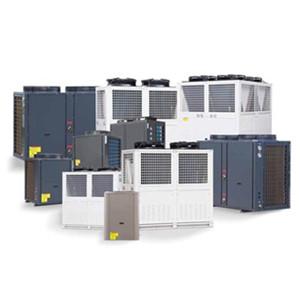
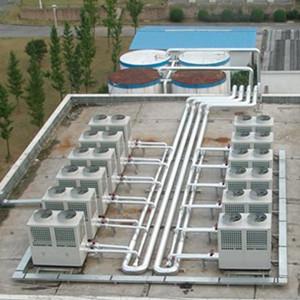
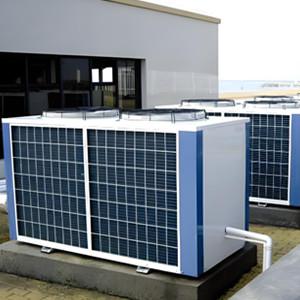
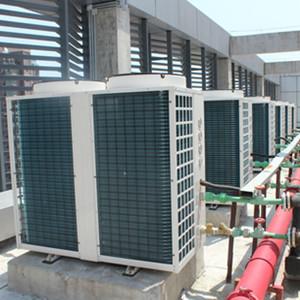
* Air source heat pumps have become the most common type of heat pump, capable of extracting thermal energy from low-temperature ambient air outside the building.
* As the technology has matured, the number of heat pump installations increased significantly between 2018 and 2022.
* Industry experts anticipate substantial improvements in heat pump energy efficiency in the coming years.
* Modern systems feature advanced capabilities such as quiet operation and smart scheduling.
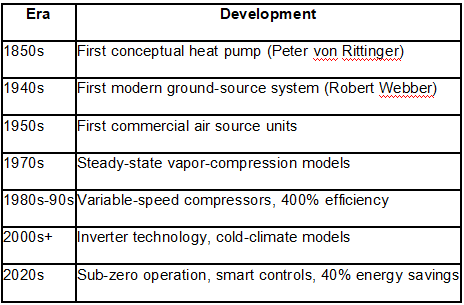
Summary of Key Technological Milestones
Conclusion
Air source heat pumps have evolved from a 19th-century scientific concept into a mature, highly efficient technology capable of both heating and cooling. The journey—spanning from Peter von Rittinger’s early experiments to today’s cold-climate systems utilizing variable-speed technology—reflects over 150 years of continuous innovation. Modern air source heat pumps operate efficiently at temperatures well below freezing, offering a sustainable alternative to fossil-fuel heating systems and playing a vital role in building electrification and efforts to combat climate change.