How Efficient Are Air Source Heat Pumps?
Air source heat pumps (ASHPs) are highly efficient. In fact, they are widely considered one of the most efficient methods for indoor heating available today.Instead of generating heat by burning fuel or using electrical resistance, heat pumps transfer existing heat from the outdoor air into your home. Because of this, their efficiency often reaches 200% or even over 400%; this means that for every unit of electricity consumed, the system delivers 2 to 4 units of thermal energy to your home.
Below is a detailed breakdown of how heat pump efficiency is measured, how they perform in cold weather, and how they compare to traditional systems.
1. Metrics for Measuring Heat Pump Efficiency
Heat pump efficiency is primarily measured using the following three metrics:
1) COP (Coefficient of Performance): Measures instantaneous efficiency. A COP of 3.0 indicates an efficiency of 300% (meaning 3 units of heat are output for every 1 unit of electricity consumed). In mild climates, modern heat pumps typically have a COP between 2.5 and 4.0.
2) HSPF2 (Heating Seasonal Performance Factor 2): Measures average seasonal heating efficiency, accounting for temperature fluctuations throughout a typical winter. As of January 1, 2023, the U.S. Department of Energy’s minimum standard is an HSPF2 of 7.5, while high-efficiency models can achieve ratings of 10.0 to over 13.0.
3) SEER2 (Seasonal Energy Efficiency Ratio 2): Measures cooling efficiency during the summer. The current minimum standard in the U.S. is a SEER2 of 14.3, while high-end models can exceed a SEER2 of 20.0.
2. Efficiency in Cold Weather ("Cold Climate" Technology Breakthroughs)
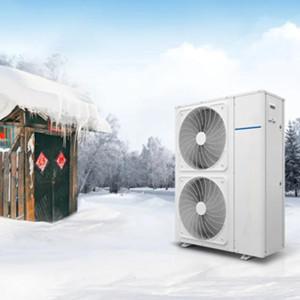
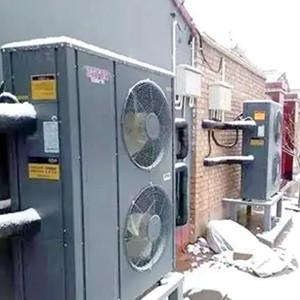
In the past, when outdoor temperatures dropped below freezing, the efficiency and heating capacity of heat pumps would decline, necessitating the activation of a backup resistance heating system (which operates at only 100% efficiency). However, modern cold-climate air source heat pumps (ccASHPs) largely overcome this issue through the following technologies:
1) They employ variable-speed compressors that can increase their speed to extract heat even when thermal energy is scarce.
2) They use new refrigerants with very low boiling points (such as R-32 or R-454B), enabling them to absorb heat from frigid air.
Performance in actual cold weather:
1) At temperatures between 30°F and 40°F (approx. -1°C to 4°C), modern ccASHPs typically achieve a Coefficient of Performance (COP) of 3.0 to 4.0 (i.e., 300%–400% energy efficiency).
2) At temperatures between 5°F and 17°F (approx. -15°C to -8°C), high-performance models can still maintain a COP of 2.25 to 2.5 (i.e., 225%–250% energy efficiency).
3) Even at temperatures as low as 0°F (-18°C), many top-tier ccASHPs deliver a COP of 2.0 to 2.5, meaning they remain twice as efficient as standard electric heating systems.
3. Energy efficiency comparison: Heat pumps vs. traditional heating systems
Note: Because heat pumps transfer heat rather than generate it, their energy efficiency cannot physically drop below 100% unless a malfunction occurs. Even in extreme cold, their raw energy efficiency almost always outperforms that of gas furnaces.
4. Factors determining actual energy efficiency
A heat pump's rated efficiency is achievable only under ideal conditions. Actual efficiency depends heavily on:
1) Proper capacity matching: Oversized heat pumps suffer from "short cycling" (frequent starting and stopping), leading to wasted energy and ineffective dehumidification; undersized units run continuously and rely heavily on less efficient auxiliary heating systems. Therefore, performing a professional Manual J load calculation is crucial.
2) Inverter technology: Single-stage (fixed-speed) heat pumps have lower energy efficiency because they operate only at either 100% power or 0% power (shut off). Inverter-driven (variable-speed) heat pumps can operate continuously at capacities such as 30% or 50%; this mode of operation is highly efficient and provides more stable indoor temperatures.
3) Building envelope (insulation and airtightness): Compared to gas furnaces (which typically deliver air at 120°F–140°F), heat pumps supply heat at lower temperatures (typically 90°F–110°F). If a home has air leaks or poor insulation, this lower-temperature heat dissipates quickly, forcing the system to work harder.
4) Ductwork quality: In ducted systems, leaks or a lack of insulation in ducts located in attics or crawl spaces can result in a loss of 20% to 30% of the conditioned airflow before it reaches the living space.
5) Installation quality: Improper refrigerant charge or incorrect airflow settings can reduce a heat pump's efficiency by 15% to 30% right from the start of operation.
Summary
Air source heat pumps are highly efficient, typically achieving operating efficiencies of 200% to 400% (a COP of 2.0 to over 4.0). Thanks to recent advancements in cold-climate technology, they maintain this high efficiency even in sub-freezing temperatures, significantly outperforming standard electric resistance heating systems and even the most efficient natural gas furnaces. To fully realize this efficiency advantage, proper equipment selection, high-quality installation, and good home insulation are essential.