Running Costs of Air Source Heat Pump
When considering switching from an oil or gas boiler to a heat pump, two costs need to be considered: upfront investment and ongoing operating costs.
In this article, we'll explore the factors that influence the operating costs of an air source heat pump, including your home's heating needs, the pump's efficiency, the level of insulation in your home, and the type and size of the heat pump you choose.
We'll also provide a comparison with a conventional boiler and reveal tips on how to maximize your annual cost savings (up to £500) with your heat pump.
1. Factors Affecting Heat Pump Operating Costs
When it comes to the economics of heat pumps, the operating costs of an air source heat pump depend on a few key factors. First is the home's heating needs, or heat demand—the greater the demand, the harder the heat pump needs to work.
Then, efficiency becomes crucial; those with a higher coefficient of performance (CoP) act like energy magicians, generating more heat with less electricity.
Proper insulation ensures that precious heat doesn't escape through gaps. Finally, size also matters—the larger the power output of an air source heat pump (measured in British Thermal Units (BTUs), the better it can handle cold environments. However, power output will also affect your electricity bill.
1) Your Home's Heating Needs
A home's heating needs are like its "food"—the larger the space, the poorer the ventilation, or the higher your preferred temperature, the more "food" it needs. This translates to the energy required to maintain your preferred comfort level.
When calculating heating needs, factors such as home size, number of rooms, and your set temperature are taken into account. Larger homes, with higher set temperatures and greater hot water demand, can see significantly higher annual heating costs.
2) Heat Pump Efficiency
Learn about the Coefficient of Performance (COP)—a metric for measuring the efficiency of your air source heat pump. If your air source heat pump has a COP of 4 or higher (for example, Leomon heat pumps have a COP of 4.7), it means that for every unit of electricity consumed, it produces four units of heat. This contrasts sharply with traditional gas boilers, which are typically only about a quarter as efficient as heat pumps. Higher energy efficiency means more warmth at a lower energy cost, even with high electricity prices.
3) Home Insulation
Think of insulation as giving your house a warm hug; it effectively protects against the cold. Whether it's wall insulation or attic insulation, good insulation reduces heat loss, significantly lowering the operating costs of an air source heat pump. Effective insulation also reduces your annual heating needs, allowing you to enjoy lower energy bills without sacrificing comfort.
4) Types and Sizes of Heat Pumps
The power of an air source heat pump depends on the size of your home and your heating needs. BTU (British Thermal Unit) is a measure of power; a higher number indicates greater power. Generally, while more powerful heat pumps are more durable and can handle colder weather, they have higher initial investment costs and higher ongoing electricity consumption (kilowatt-hours). At Leomon, we recommend the most suitable air source heat pump based on your specific needs through a free home energy assessment.
2. Comparison of Operating Costs for Boilers and Air Source Heat Pumps
Several factors need to be considered when weighing the costs of heat pumps and traditional gas boilers. While air source heat pumps are more efficient, their annual heating and hot water costs may be higher than those of gas boilers due to differences in electricity and gas prices. However, a long-term perspective is crucial, as it's essential to clearly see the cost savings.
Firstly, you can save approximately £114 annually in fixed gas costs because you no longer need a gas boiler and a gas connection.
Furthermore, since heat pumps require no regular maintenance, you avoid the approximately £120 annual repair costs associated with boilers. Additionally, you won't need to pay for boiler insurance, which can cost up to £39 per month.
Next, the quality of the air source heat pump's installation and your usage habits are also critical. If installed properly and you set a target temperature and allow the heat pump to maintain it automatically, you can save even more on energy bills. Moreover, with Leomon Smart Technology, your Leomon heat pump can continuously learn and automatically adjust to your family's lifestyle, resulting in even greater energy savings over time.
Furthermore, if you combine your heat pump with a smart pricing plan like Cosy Octopus, you can save up to £550 per year on your energy bill. Let's illustrate this with a real-world example:
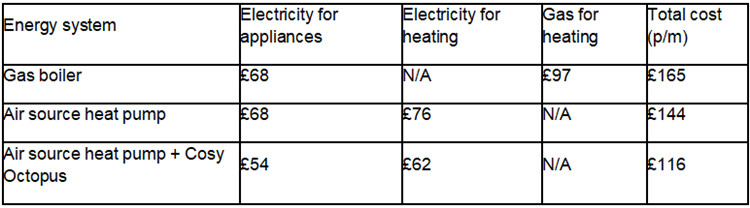
*These costs are for illustrative purposes only and are based on the assumptions presented in the infographic at the top of this page. The savings do not include the approximately £39 per month for gas boiler insurance.
Keep in mind that these potential savings also come with the added benefit of reducing carbon emissions from home heating, which can be reduced to zero with a smart Octopus Energy plan like Cosy Octopus.
While the upfront costs may be higher than with traditional heating systems, and home insulation (such as attic insulation) may need improvement, ultimately, investing in an air source heat pump can reduce energy costs even with fluctuating electricity prices.
3. How to Save on Air Source Heat Pump Operating Costs
Understanding the operating costs of an air source heat pump is crucial for reducing your energy bill while maintaining comfort! First, install thick insulation in your home to reduce heat loss—this keeps precious warmth where you need it, minimizing heat pump runtime and saving money.
Your air source heat pump itself works well, but regular maintenance, such as ensuring there's no debris around the fan, will ensure smooth operation and further reduce operating costs.
Additionally, you can control it via a thermostat or app. To reduce air source heat pump operating costs, it's best to set a target temperature and the amount of hot water the system needs, then let the system run in the background. Heat pump technology is far more advanced than gas and oil boilers, designed to heat and hot water your home in the most efficient way.
Finally, there are clean energy heat pump packages like the Cosy Octopus. This air source heat pump package allows Leomon to adjust the system based on your energy prices, providing heating and hot water when energy prices are low and using stored heat and hot water during peak hours when energy prices are high. This reduces your energy costs without compromising comfort.